The UK has undergone substantial changes in the last two years with relation to the National Minimum Wage. For small and medium-sized enterprises (SMEs) across the United Kingdom, the 2026 National Minimum Wage rise represents a significant financial challenge, particularly when combined with rising National Insurance contributions and ongoing economic pressures. Understanding these changes and having access to the right funding solutions is crucial for business survival and growth.
This comprehensive guide examines the 2025 and 2026 National Minimum Wage rise, the impact on UK SMEs, and how Capify’s flexible business lending solutions can help your company manage increased payroll costs whilst maintaining operational stability.
Understanding the 2025 and 2026 National Minimum Wage rise
The UK government implemented significant minimum wage increases in April 2025 and April 2026. These changes affect over 3 million workers across the country, particularly in labour-intensive sectors such as hospitality, retail, and personal services.
April 2025 Minimum Wage Rates
From 1 April 2025, the National Living Wage increased by 6.7% to £12.21 per hour for workers aged 21 and over. This represents a substantial rise from the previous rate of £11.44 per hour. Younger workers saw even more dramatic increases, with the 18-20 age group experiencing a record 16.3% rise.
| Worker Category | Hourly Rate (2024) | Hourly Rate (April 2025) |
| National Living Wage (21+) | £11.44 | £12.21 |
| 18-20 year olds | £8.60 | £10.00 |
| 16-17 year olds | £6.40 | £7.55 |
| Apprentices | £6.40 | £7.55 |
| Accommodation offset | £9.99/day | £10.66/day |
April 2026 Minimum Wage Rates
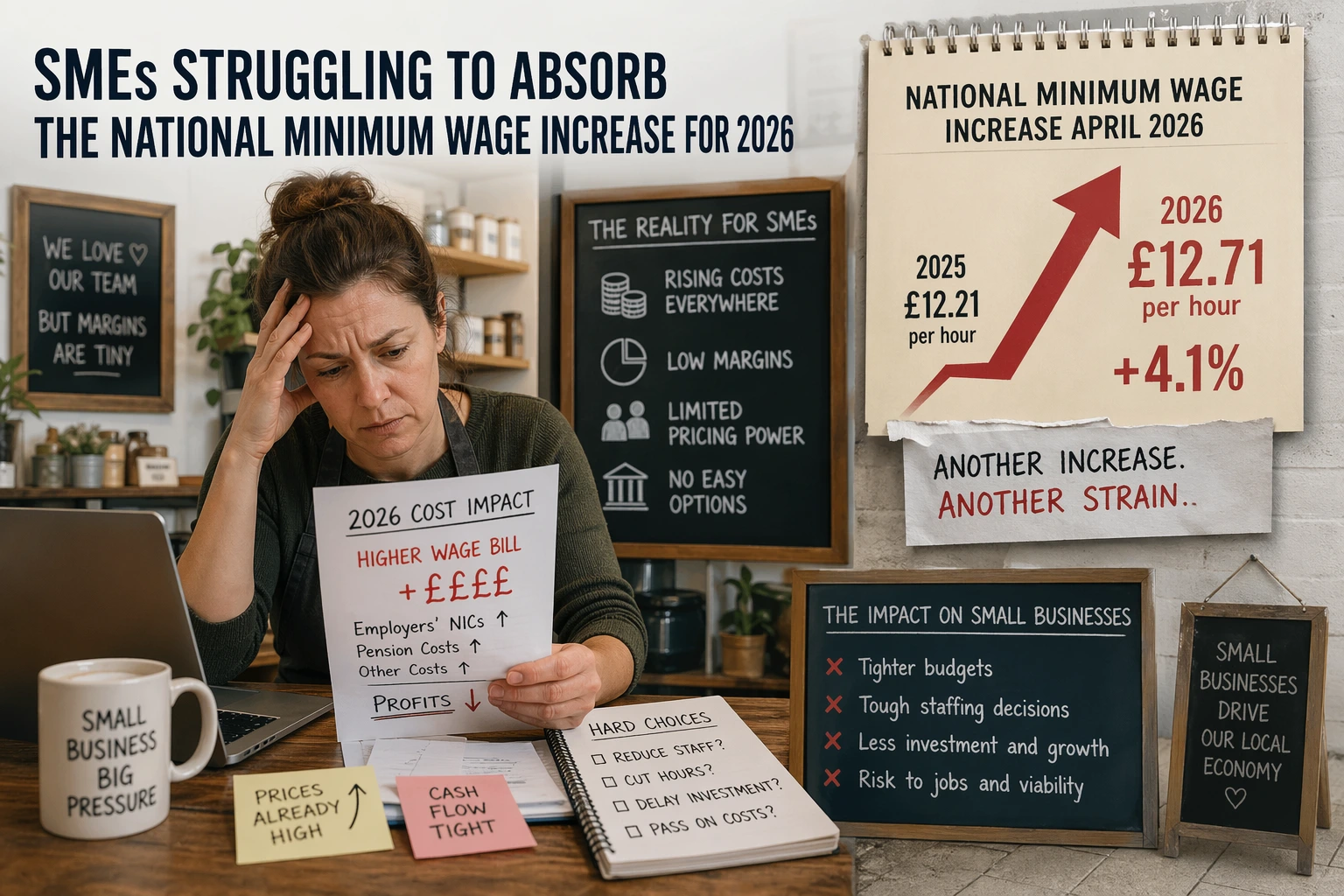
The government has confirmed further increases for April 2026, continuing the trajectory towards a single adult wage rate. The 2026 National Minimum Wage rise increases the 2025 rate by 4.1% to £12.71 per hour, whilst younger workers will see an 8.5% increase.
| Worker Category | Hourly Rate (April 2025) | Hourly Rate (April 2026) |
| National Living Wage (21+) | £12.21 | £12.71 |
| 18-20 Year Olds | £10.00 | £10.85 |
| 16-17 Year Olds | £7.55 | £8.00 |
The Real Financial Impact on UK SMEs
The minimum wage increases alone represent a substantial cost burden, but SMEs face a compounding effect when combined with other fiscal changes implemented in 2025.
Cumulative Cost Pressures
Between April 2025 and April 2026, SME employers are absorbing a National Living Wage increase of over 11% in just two years. However, this is only part of the story. Additional cost pressures include:
- Employer National Insurance Contributions (NICs) increased from 13.8% to 15% in April 2025
- The NICs threshold reduced from £9,100 to £5,000, meaning employers pay NICs on more of each employee’s salary
- Wage compression effects, where experienced staff expect proportional increases to maintain pay differentials
- Ongoing inflation affecting operating costs, supplies, and overheads
Real-World Cost Examples
For an employee working 35 hours per week on the National Living Wage, the combined cost of the wage increase and higher NICs means employers will pay approximately £2,270 more per employee annually from April 2025 onwards. A small retail business with 10 minimum-wage employees could face an additional £22,700 in annual payroll costs.
These increases particularly affect labour-intensive sectors. According to recent surveys, 28.9% of UK businesses plan to increase prices to offset employment costs, whilst 22.7% expect to absorb the costs within profit margins, and 10.6% are considering reducing employee numbers.
Sectors Most Affected by Minimum Wage Increases
The wage increases have disproportionate impact across different sectors:
- Hospitality and Food Service: With over 1 million workers affected nationally, restaurants, pubs, and cafes face significant margin pressure
- Retail: High volumes of part-time and minimum-wage staff mean retail SMEs experience substantial payroll increases
- Personal Services: Hair salons, beauty therapists, and care providers operate on tight margins with limited pricing flexibility
- Manufacturing: Assembly and production roles often pay minimum wage, creating significant cost increases for manufacturers
- Agriculture: Seasonal workers and farm staff wages directly impact already-slim agricultural margins
How Capify’s Business Funding Solutions Support SMEs Through Wage Increases
As a leading B2B alternative lender, Capify specialises in providing flexible, unsecured business loans to UK SMEs facing cash flow challenges. When minimum wage increases strain your working capital, we offer fast-access funding solutions designed specifically for businesses like yours.
Short-Term Business Loans for Payroll Management
Capify’s short-term business loans provide immediate capital injection to cover increased payroll costs whilst you adjust your business model. Unlike traditional bank loans that can take weeks or months to secure, our streamlined application process means you can access funds quickly, often within 24-48 hours of approval.

Key benefits include:
- Loan amounts from £5,000 to £1,000,000 to match your specific needs
- Flexible repayment terms from 3 to 18 months
- Quick application and approval process with minimal paperwork
- No early repayment penalties, giving you flexibility to manage your finances
Unsecured Business Loans – No Assets Required
One of Capify’s key advantages over traditional lenders is our provision of unsecured business loans. You don’t need to put up property, equipment, or other assets as collateral. This removes significant risk from your business and accelerates the application process.
Unsecured loans are particularly valuable for SMEs that:
- Don’t own significant business assets
- Want to preserve existing assets for other purposes
- Need funding quickly without lengthy valuation processes
- Operate service-based businesses with limited physical collateral
Alternative Lending Solutions Tailored for UK SMEs
Unlike many high street banks and some alternative lenders, our approach focuses on understanding your business’s unique circumstances and revenue patterns. We look beyond traditional credit scores to assess your business’s actual performance and potential.
Our alternative lending criteria consider:
- Your monthly revenue and cash flow patterns
- Time in business and trading history
- Seasonal fluctuations and industry-specific challenges
- Future growth potential and business strategy
Strategic Uses for Business Loans During Wage Transitions
Whilst the immediate need may be payroll coverage, Capify’s business loans can support several strategic initiatives that help your business absorb wage increases sustainably:
Bridging Cash Flow Gaps
Use short-term funding to bridge the gap between increased wage obligations and price adjustments or efficiency improvements. This prevents the need for drastic measures like staff redundancies whilst you implement longer-term solutions.
Investing in Productivity Enhancements
Consider using business funding to invest in technology, training, or process improvements that increase productivity. Higher output per employee hour can offset increased wage costs. Examples include:
- Point-of-sale systems and inventory management software
- Staff training programmes to improve efficiency and service quality
- Equipment upgrades that reduce manual labour requirements
- Digital marketing to increase revenue per employee
Inventory and Stock Management
For retail and hospitality businesses, optimising inventory with better purchasing power can improve margins. Business loans enable bulk purchasing at better rates, improving your overall cost structure to accommodate higher wages.
Marketing and Revenue Growth Initiatives
Growing your revenue base is often more sustainable than cost-cutting alone. Use funding to launch marketing campaigns, expand service offerings, or open new revenue channels that increase turnover without proportionally increasing labour costs.
Why UK SMEs Choose Capify Over Traditional Lenders
When facing the urgent cash flow pressures created by minimum wage increases, SMEs need a lending partner that understands speed, flexibility, and practical business realities. Here’s why thousands of UK businesses choose Capify:
Speed of Funding
Payroll deadlines don’t wait for lengthy bank approval processes. Capify’s streamlined application can be completed online in minutes, with approval decisions made within hours. Once approved, funds can be in your account within 24-48 hours – this can be critical when payroll is due.

Flexible Eligibility Criteria
Traditional banks often reject SME applications based on rigid credit criteria. Capify looks at the full picture of your business performance. We consider:
- Businesses trading for as little as 12 months
- Companies with variable monthly revenues
- Businesses in traditionally ‘high-risk’ sectors like hospitality and retail
- SMEs recovering from temporary setbacks
Transparent Terms and Pricing
Capify provides clear, upfront information about loan costs, repayment schedules, and terms. No hidden fees, and no surprise charges – just straightforward business lending that helps you plan accurately.
Dedicated Account Management
Every Capify client receives dedicated support from experienced account managers who understand UK SME challenges. We’re here to answer questions, provide guidance, and help you navigate financial decisions, not just process applications.
Proven Track Record with UK SMEs
Capify has successfully funded thousands of UK businesses across all sectors, helping them overcome cash flow challenges, seize growth opportunities, and navigate economic changes. Our reputation is built on delivering what we promise; fast, flexible funding when businesses need it most.
Practical Steps for Managing the 2026 National Minimum Wage rise
Beyond securing funding, SMEs should take proactive steps to manage the ongoing impact of wage increases:
Conduct a Comprehensive Payroll Audit
Identify every employee affected by minimum wage changes and calculate the precise cost impact including NICs. This provides an accurate baseline for financial planning and funding requirements.
- Calculate the total annual cost increase from wages and NICs
- Review salary sacrifice schemes to ensure compliance with new minimum wage levels
- Model potential wage compression effects across your entire workforce
Review Pricing Strategies
If increased labour costs cannot be fully absorbed, consider measured price adjustments. Industry data shows that customers generally accept modest price increases when quality and service remain consistent, particularly when they understand the context of rising minimum wages.
- Implement incremental increases rather than sudden large jumps
- Consider introducing premium service tiers rather than across-the-board increases
- Communicate transparently with customers about wage-related cost pressures
Optimise Operational Efficiency
- Evaluate every aspect of your operations to identify efficiency improvements that reduce labour hours required per unit of output:
- Streamline processes to eliminate redundant tasks
- Cross-train staff to improve flexibility and reduce overtime needs
- Implement scheduling software to optimise staffing levels
- Review peak and off-peak patterns to adjust staffing accordingly
Plan for 2026 and Beyond

With April 2026’s minimum wage increase already in place and the government’s stated goal of creating a single adult wage rate, SMEs must plan for ongoing wage growth. Build wage escalation assumptions into your financial forecasting and business planning to avoid being caught unprepared by future increases.
How to Apply for Capify Business Funding
Accessing Capify’s business loans is straightforward and designed for busy SME owners who need solutions quickly:
Step 1: Complete the Online Application
Visit the Capify website and complete our simple online application form. You’ll need basic information about your business, trading history, and funding requirements. The process typically takes just 10-15 minutes.
Step 2: Speak with a Funding Specialist
A Capify funding specialist will contact you to discuss your application, understand your specific needs, and explain the available options. This consultation ensures you receive funding that truly matches your requirements.
Step 3: Receive Your Decision
Capify provides rapid decisions on applications, often within hours. We’ll clearly explain the approved loan amount, repayment terms, and total cost so you can make an informed decision.
Step 4: Access Your Funds
Once you accept the offer and complete any final documentation, funds are transferred directly to your business bank account — typically within 24-48 hours. This means you can meet payroll obligations on time without stress or delay.
Frequently Asked Questions About Minimum Wage Increases and Business Funding
What was the previous UK minimum wage?
From 1 April 2025, the National Living Wage is £12.21 per hour for workers aged 21 and over. The National Minimum Wage for 18-20 year olds is £10.00 per hour, whilst 16-17 year olds and apprentices receive £7.55 per hour.
When will the minimum wage increase again?
The next minimum wage increase is confirmed for 1 April 2026, when the National Living Wage will rise to £12.71 per hour (a 4.1% increase), and the 18-20 rate will increase to £10.85 per hour (an 8.5% rise).
How much will the minimum wage increases cost my business?
For an employee working 35 hours per week on the National Living Wage, the April 2026 increase from £12.21 to £12.71 per hour means employers will pay approximately £1,047 more per employee annually. This calculation includes the additional employer National Insurance Contributions (15%) on the wage increase. A small retail business with 10 minimum-wage employees could face an additional £10,470 in annual payroll costs from April 2026 onwards. Cumulatively, when combined with the 2025 increases, these employers will be absorbing over £33,000 in additional wage-related costs across just two years.
SMEs should conduct a full payroll audit to determine their specific impact.
Can I get a business loan to cover increased wage costs?
Yes. Capify specialises in providing short-term and unsecured business loans to UK SMEs needing to manage increased payroll costs. Our loans range from £5,000 to £1,000,000 with flexible repayment terms, and funds can be accessed within 24-48 hours of approval.
What is an unsecured business loan?
An unsecured business loan does not require you to put up assets (property, equipment, inventory) as collateral. This reduces risk to your business and speeds up the application process, as no asset valuations are required. Capify offers unsecured loans based on your business’s trading performance and revenue.
How quickly can I access business funding from Capify?
Capify’s streamlined process means you can receive funding within 24-48 hours of approval. The online application takes just 10-15 minutes, approval decisions are made within hours, and funds are transferred directly to your business account as soon as documentation is completed.
Which sectors are most affected by minimum wage increases?
Labour-intensive sectors face the greatest impact, including hospitality and food service (over 1 million affected workers nationally), retail, personal services (salons, care providers), manufacturing, and agriculture. These sectors typically employ higher proportions of minimum-wage workers and operate on tighter profit margins.
Do I need good credit to get a business loan from Capify?
Do I need good credit to get a business loan from Capify?
Capify looks beyond traditional credit scores to assess your business’s actual performance and potential. We consider monthly revenue, trading history, cash flow patterns, and business strategy. Even businesses with imperfect credit histories may qualify based on current trading performance.
What are the alternatives to taking a business loan for wage increases?
Alternatives include raising prices, reducing staff hours or headcount, improving operational efficiency, or absorbing costs within profit margins. However, many SMEs find that strategic use of short-term funding provides breathing room to implement longer-term solutions without drastic measures like redundancies.
How is Capify different from Iwoca, Fleximize, Funding Circle and other alternative lenders?
Capify specialises in understanding the unique challenges facing UK SMEs and provides personalised funding solutions rather than one-size-fits-all products. Our focus on speed, flexibility, dedicated account management, and transparent terms sets us apart. We assess your business holistically, considering factors beyond just credit scores, and provide funding that matches your specific cash flow patterns and business needs.
Take Control of Your Business’s Financial Future
The UK minimum wage increases for 2025 and 2026 represent substantial cost pressures for SMEs, but with proper planning and access to the right funding solutions, your business can navigate these changes successfully.
Capify’s short-term, unsecured business loans provide the flexible capital you need to manage increased wage obligations whilst you implement strategic initiatives to improve efficiency, grow revenue, or adjust your business model. Our fast application process, transparent terms, and dedicated support make Capify the ideal partner for UK SMEs facing financial challenges.
Don’t let minimum wage increases threaten your business stability. Contact Capify today to discuss how our tailored funding solutions can support your business through 2025, 2026, and beyond.
Ready to secure the funding your business needs?