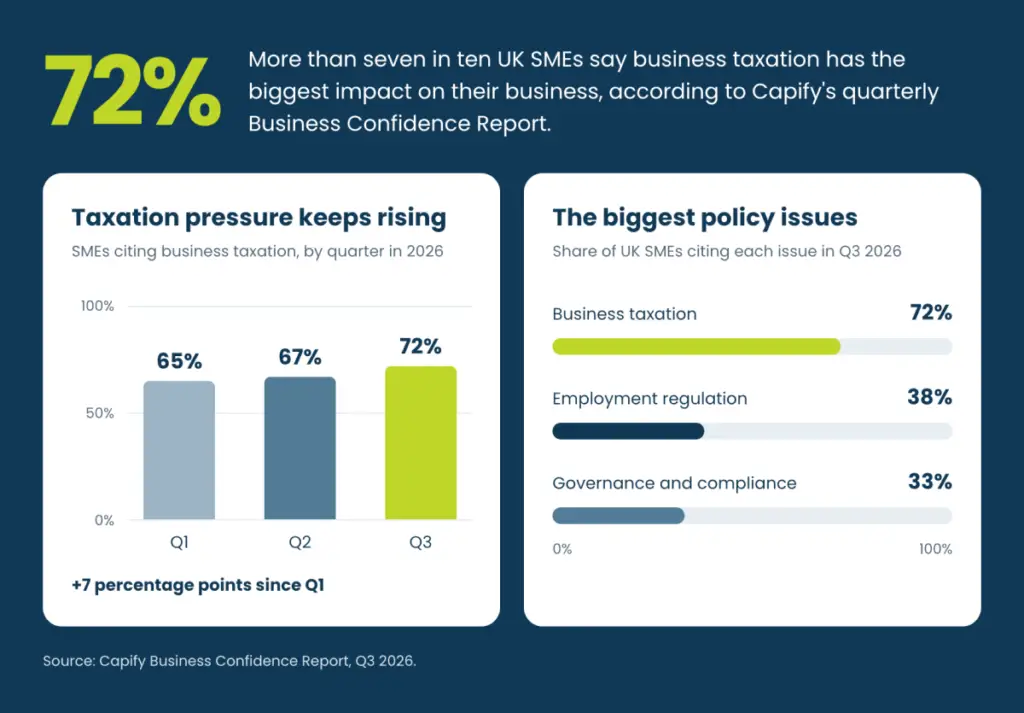
More than seven in ten UK SMEs (72%) say business taxation has the biggest impact on their business, according to Capify’s latest quarterly Business Confidence Report.
The figure has risen in every survey this year, from 65% in Q1 to 67% in Q2 and 72% in Q3. Taxation is now well ahead of the next biggest policy issues, employment regulation (38%) and governance and compliance (33%).
Tax bills and cash flow
For the first time, the survey asked SMEs how tax bills affect their cash flow.
Most businesses know what they owe. 56% have complete visibility of their upcoming VAT and Corporation Tax payments, and a further 29% have some visibility.
But 39% say they would find it difficult to pay their next VAT or Corporation Tax bill from available cash if it were due today, including 20% who would find it significantly difficult. Almost half (48%) have faced cash flow problems because of an unexpected or higher-than-expected tax bill, and 13% say this happens frequently.
John Rozenbroek, COO and CFO at Capify, said: “Most small business owners know exactly what they owe the taxman. The challenge is having the cash in the bank on the day the bill falls due.”
When asked what changes from government would most improve their confidence, SMEs put cuts to Corporation Tax (60%) and employer National Insurance contributions (59%) at the top of the list, followed by lower energy costs (48%).
Late payments
Late payment remains a pressure on cash flow. Almost two-thirds of SMEs say late payments have a significant or some impact on how they operate. A third say payment delays from customers have increased over the past 12 months.
“When customers pay late, as they do for two-thirds of the businesses we surveyed, a tax bill that was planned for can still arrive at exactly the wrong moment,” said Rozenbroek.
Investment and the cost of opportunity
Just over half of SMEs plan to invest in their business during 2026. The most common areas are marketing (17%), equipment (17%), AI (16%) and people (16%).
Economic uncertainty is the main factor holding back investment, cited by 53%. It is followed by affordability and the cost of opportunity (38%) and business confidence (37%).
Confidence and trading conditions
Confidence has fallen since the summer. Just 9% of SMEs feel confident about the UK economic outlook, down from 22% in Q2, and 64% describe themselves as unconfident.
Confidence in their own business is higher, at 41%, but has fallen from just over half in Q1 and Q2.
Revenue expectations have also shifted. A quarter of SMEs expect revenues to increase over the next six months, while 43% expect a decrease, up from 21% in Q2. Customer budgets are the main factor influencing demand, cited by 64% of businesses.
Costs continue to rise, with 70% reporting higher operating costs this quarter than last. 47% are confident they can maintain their current margins for the rest of the year, compared with 55% in Q2.
Workforce
Most SMEs are keeping staff numbers steady. 79% plan to maintain their current headcount over the next six months, 5% plan to recruit and 16% expect to reduce staff.
The biggest staffing challenge has shifted from recruitment to cost. Rising wage expectations are now the most common challenge (27%), while the share citing recruitment of skilled employees has fallen from 25% in Q2 to 13%.
Access to finance
Four in ten SMEs (40%) say it is difficult to access finance or credit, including 6% who describe it as very difficult.
Overdrafts (29%) and credit cards (29%) are the sources of finance SMEs are most likely to use in 2026, followed by bank loans (18%). Alternative finance is the most popular option beyond traditional borrowing, with one in seven SMEs (14%) expecting to use a loan from an alternative lender.
Resilience
Despite the pressures, 69% of SMEs describe their business as very or somewhat resilient to economic shocks, a figure that has held steady throughout 2026.
Read the full report
The Capify SME Business Confidence Report Q3 2026 includes the full findings on tax, cash flow, confidence, investment, hiring and access to finance.
Need finance to tackle a tax bill or make the most of an opportunity?
Check your eligibility
in 30 seconds without affecting your credit score.
*The report is based on a survey of 175 SME owners and decision-makers in September 2026.