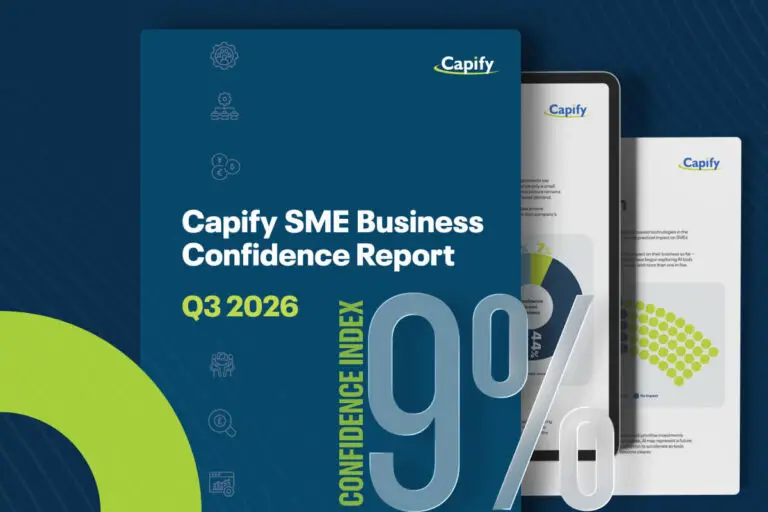
VAT bills are a worry for many small and medium-sized businesses. In fact, more than half of respondents in the recent Capify Business Confidence Report said reducing VAT would be the best way to support their growth.
Every quarter, thousands of profitable UK businesses receive a VAT bill they can’t immediately pay. The important thing is not to ignore the problem. The earlier you act, the more options you have.
In this guide, we’ll explain five practical ways to deal with a VAT bill you can’t afford immediately, what happens if you do nothing, and how to choose the right solution for your business.
What is VAT?
Some new business owners find it hard to understand VAT, so let’s break it down quickly. Jump ahead if you know the basics.
VAT (Value Added Tax) is a tax added to products and services sold by VAT-registered businesses. Businesses have to register for VAT if their VAT taxable turnover is more than £90,000 per year.
There are three VAT rates:
- Standard Rate (20%): Applies to most goods and services.
- Reduced Rate (5%): Applies to specific items like home energy and children’s car seats.
- Zero Rate (0%): Applies to essential goods, including most basic food items and children’s clothes.
VAT-registered businesses add the relevant rate to their prices and collect the funds. But this is not their money; they are just holding it for the government and have to pass it on every three months (minus any VAT their business has paid out).
Managing VAT as part of cash flow can be a real challenge. The funds can help with liquidity, but problems arise if they are not available when the VAT bill is due.
(Businesses with a VAT turnover of less than £150,000 may be able to join a simpler VAT Flat Rate Scheme with a fixed rate of VAT. There is also a HMRC VAT Estimator Tool that shows what VAT might be owed or reclaimed by your business when you register for VAT.)
Learn more about VAT from the Federation of Small Businesses.
What should you do if you can’t pay your VAT bill?
If you know you’re unlikely to pay your VAT bill by the deadline:
- Don’t ignore it or hope the problem will disappear.
- Work out exactly how much you owe and when payment is due.
- Review your cash flow to see whether the shortfall is temporary.
- Contact HMRC as early as possible if you need support.
- Consider the full range of options to help protect your cash flow.
Taking action early usually gives you more flexibility than waiting until after you’ve missed the payment deadline.
Why do businesses struggle to pay VAT?
Many business owners feel embarrassed about finding themselves in this position, but it’s surprisingly common.
The challenge is that VAT isn’t your business’s money – you’re collecting it on behalf of HMRC. However, cash flow doesn’t always work as neatly as the tax calendar.
Some of the most common reasons businesses struggle with VAT payments include:
- Customers paying invoices late.
- Seasonal peaks and troughs in income.
- Unexpected equipment or repair costs.
- Taking on new staff or investing in growth.
- Rising supplier costs reducing available cash.
- Several large bills falling due at the same time.
None of these necessarily means your business is failing. In many cases, it’s simply a timing issue between money coming in and money going out.
Option 1: Pay using existing cash reserves
If you have savings available, using them may be the simplest solution.
Paying your VAT bill on time avoids interest and penalties and means you can move on without further discussions with HMRC. However, think carefully before emptying your cash reserves.
Keeping some working capital available can help you manage payroll, supplier payments and unexpected expenses. Using every available pound to settle a tax bill could leave your business exposed if another challenge arises a few weeks later.
The right decision depends on your wider financial position and upcoming commitments.
Option 2: Apply for an HMRC Time to Pay arrangement
If you can’t pay your VAT bill in full, HMRC may agree to let you spread the payments over a longer period through a Time to Pay arrangement.
These agreements are designed for businesses experiencing temporary financial difficulties rather than long-term insolvency. If accepted, you’ll make regular payments instead of paying the full amount immediately.
Remember – it’s generally better to contact HMRC before your payment deadline rather than after you’ve already missed it. Being proactive demonstrates that you’re trying to resolve the situation and can improve your chances of reaching an agreement.
Time to Pay won’t be suitable for every business, and HMRC will want to understand your circumstances before agreeing to a payment plan.
Read our guide to HMRC Time to Pay for VAT: How It Works & How to Apply to learn more.
Option 3: Consider business finance
Sometimes preserving cash flow is the most valuable decision a business can make.
Rather than tying up all your available cash in a single VAT payment, some businesses choose to use finance to cover the bill while repaying the loan over time.
This approach can help you:
- Maintain healthy working capital.
- Continue investing in growth.
- Pay suppliers on time.
- Avoid disrupting day-to-day operations.
- Meet your tax obligations without putting the business under unnecessary pressure.
Whether this is the right approach depends on your circumstances, future income and the cost of borrowing.
Our guide to VAT Loan vs HMRC Time to Pay: Which Is Right for Your Business? explains the pros and cons of both options.
Option 4: Improve your short-term cash flow
The money you need may already be owed to your business, so before assuming you need external funding, it’s worth looking for opportunities to improve cash flow quickly.
You could:
- Chase overdue customer invoices.
- Ask customers to settle outstanding balances sooner.
- Delay non-essential purchases.
- Review subscriptions and discretionary spending.
- Negotiate extended payment terms with suppliers where appropriate.
- Invoice promptly for completed work.
Even modest improvements across several areas can make a significant difference to the amount of cash available.
Check out our Cash Flow Hub for more information and guides.
Option 5: Speak to your accountant
Your accountant sees your business finances from a wider perspective than any individual VAT return.
They may be able to identify:
- Upcoming cash flow issues.
- Opportunities to improve forecasting.
- Better ways to manage VAT throughout the year.
- Tax planning that improves your financial resilience.
If VAT bills regularly create pressure, it’s worth reviewing your cash flow forecasting process rather than treating each deadline as a separate problem.
Check out our Cash Flow Forecasting guide.
What happens if you ignore your VAT bill?
Doing nothing is usually the most expensive option.
If you fail to pay your VAT bill, HMRC may charge interest on the outstanding amount. Depending on the circumstances, penalties may also apply, particularly if payments continue to be missed or returns aren’t submitted on time.
Ignoring the issue can also make it more difficult to agree payment arrangements later. The sooner you address the situation, the more options you’re likely to have.
Frequently asked questions
Can I pay my VAT bill late?
You can, but HMRC may charge interest on the outstanding amount and additional penalties could apply depending on your circumstances. It’s usually better to contact HMRC before the payment deadline if you know you’ll struggle to pay.
Can HMRC let me pay in instalments?
Yes. HMRC offers Time to Pay arrangements for some businesses experiencing temporary financial difficulties. Approval isn’t automatic, so it’s important to contact HMRC as early as possible. Applications can be made online.
Can I get finance to pay a VAT bill?
Many businesses use finance to help manage cash flow around tax payments. The right solution depends on your financial position, future income and borrowing costs.
Flexible finance may be able to help
If paying your VAT bill in full would put unnecessary pressure on your working capital, Capify could help you explore funding options that allow you to meet your tax obligations while keeping your business moving forward. We understand the realities of SME cash flow and can often help when banks say no.
Complete our eligibility checker to see what you could borrow.
Important: This article provides general guidance only and should not be considered tax, legal or financial advice. HMRC rules, payment arrangements and tax regulations may change over time. Always refer to the latest guidance published by HMRC on GOV.UK and consider speaking with a qualified accountant, tax adviser or HMRC directly before making financial decisions.