1. There is still an appetite for investing in ‘going green’
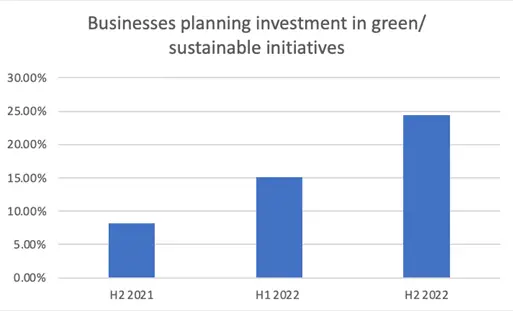
The Capify Business Confidence Survey has tracked the number of SME businesses planning on making investment into green or sustainable initiatives over the past 18 months. Despite challenges over cash flow, cash in bank and a significant decline in overall business confidence, the sustainability imperative has steadily climbed in importance to SME owners.
As the graph below highlights, ESG and sustainability are becoming increasingly important areas of investment for UK SMEs.
2. Consumers are driving change
According to Deloitte’s 2021 sustainability and consumer report, 32% of consumers were highly engaged with adopting a more sustainable lifestyle and want brands to lead the charge. Accelerated by much greater public awareness of environmental damage and the role humans play in it, 64% of consumers want brands to reduce packaging, 50% want more information on how to recycle and 46% said they desire clarity on sourcing of products.
This trend is accelerated when looking at different generational cohorts. Younger consumers are much more likely to identify with, and indeed work for, a brand or service that demonstrably shares its values and is committed to purpose over profits.
3. Sustainability delivers competitive advantage
There is a growing body of evidence that suggests companies with strong ESG credentials will outperform their peers. According to a recent best practice guideline by the Institute of Chartered Accountants England and Wales (ICAEW) – ESG in Deals and Investment – “ESG and corporate performance are intrinsically linked. Recent studies have consistently highlighted that firms that perform strongly across all the material factors of ESG outperform the market and generate long-term value. ESG should now be regarded as a key driver of value”.
4. Investors are attracted to ESG-focused businesses
At the larger end of the spectrum, investors managing over $100 trillion of Assets Under Management (AUM) have committed to the United Nations (UN) Principles for Responsible Investment (PRI), while over $130 trillion of assets were committed to a net zero target as part of the Glasgow Financial Alliance for Net Zero (Gfanz) during the COP26 climate meeting in 2021.
Beyond these commitments – and potentially more applicable to SME targets – Edelman’s Institutional Investor Trust Report highlighted that 88% of investors monitor ESG Key Performance Indicators (KPIs) to inform investment decisions on an ongoing basis. The result of this tranche of capital looking for strong ESG performing companies has led to an increase in the demand for, and consequently the value of, ESG-aligned businesses.
5. Finance is proving a barrier to realising ambitions
For many SMEs, accessing the finance required to make the transition to net zero – or at least toward a more sustainable operating model – is proving problematic.
According to the Organisation for Economic Co-operation and Development (OECD) report ‘Financing SMEs for sustainability’, 27% of European SMEs identify a lack of financial resources as the main reason preventing them from becoming more
sustainable. The report recognises that SMEs often struggle to secure finance from traditional sources, especially when that money is required for ESG initiatives. “In addition to the longstanding challenges that SMEs face in accessing finance” the report says, “SMEs seeking to undertake sustainable and green actions face additional barriers to fund these activities.”
Indeed, Capify’s Q4 Business Confidence Survey revealed that 58% of respondents were not confident of securing external finance from their existing banking partners.
There are many advantages to pursuing a more ESG-focused business operation. From market differentiation, to attracting talent, to realising value in an exit, the potential rewards for SMEs are manifold. But making the necessary changes could be costly for your clients and they may require external funding to help realise their ambitions.
Please speak to your Capify Broker representative for more information on our funding solutions.
To find out more about the commercial benefits of sustainable business, read our article here